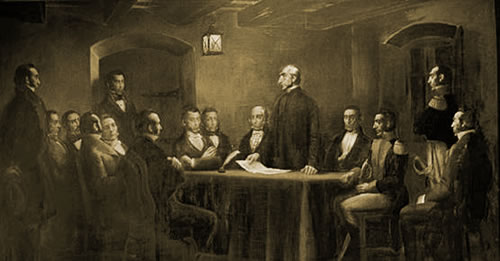
Independence Declaration.
Shortly after the "33 Orientales" disembarkation, uprising of the campaign of the Oriental Band, Lavalleja constituted a Provisional Government of the Oriental Province, and called to the city Halls to name its representatives for a Room to be met in the village of San Fernando de la Florida with the objective to proceed to to declare the independence.
August 20,1825 were installed in the town of Florida, the Room of Representatives of the Oriental Province. It was presided by the Deputy of Guadalupe, Juan Francisco Larrobla; being vice-president Luis Eduardo Perez and secretary Felipe Alvarez de Bengochea.
A Commission was designated immediately to make a annulatory Declaration of the acts from incorporation to Brazil and Portugal. After it, it paid attention to the necessity to erect an authority with executive functions, by which was appointed to the Gral. Juan Antonio Lavalleja as Governing and General Captain, and the Departments of Government were created, of War and of Estate.
August 25, 1825, the Room of Representatives approved two constitutional Laws; by the first one was declared the independence, and by the second the union to the Provinces you United of the "Rio de la Plata"was arranged.The Law of Independence the Room invoked as foundation "The extraordinary and ordinary sovereignty that invests to constitute the political existence of the towns that compose it and arranged:
1st. - To Declare void, null, dissolved and of no value for always all the acts of incorporation, aclamations and oaths uprooted to the towns of the Oriental Province by the violence of the force, together with perfidia of the intruders powers of Portugal and the Brazil, have tyrannized who it, trod and usurped their inalienable rights, and holding it to the yoke of an absolute despotism from year 1817 to the 1825 present.
2nd. - Consequently of the antecedent declaration, reassuming the Oriental Province the fullness of the rights, inherent liberties and prerogatives to the other Earth towns is declared completely, free and independent of the King of Portugal, of the Emperor of the Brazil and of any another of the Universe, and with extensive and full to be able to be given the forms that in use and exercise of its Convenient.
The Law of Union arranged:
The Honorable Room of Representatives... declares: That its decisive, solemn, constant, and general vote, is and must be by the Union with the other Argentinian Provinces, to whom always belonged for the most sacred bonds than the world knows. Therefore it has sanctioned and decrees for constitutional law the following one:
It remains the Oriental Province of the "Rio de la Plata", united to the others of this name in the territory of South America. Another Law sanctioned in the same date, arranged the creation of the national flag.
With the disembarkation of the "33 Orientales" a revolutionary process began, the second in the history of our country.
Since April 19 the authority in fact fell in the Gral. Juan A. Lavalleja that called to the towns to appoint its representatives, for integrate a Provisional Government. Under the presidency of Manuel Calleros, begins to act June 14, 1825. This Government called immediately to a Room of Representatives of the Towns, of our territory, that met in the Village of the Florida.
August 20, 1825 remained finally installed, with fourteen members, under the presidency of the priest of Canelones Juan Francisco Larrobla. After several sessions in which a series of resolutions were dictated, the Provincial Government with an Executive Power in charge of the Gral Lavalleja and a Legislative Power in charge of the Room of Representatives was organized. On August 25, 1825, promulgated three constitutional laws:
INDEPENDENCE LAW
Between the aspects most important we firstly emphasized the invalidity of “… all the acts of incorporation, recognitions, aclamations and oaths uprooted to the Towns of the Oriental Province, by the violence of the force together with perfidia of the intruders powers of Portugal and Brazil…” In the second part it establishes the power to reassume its rights totally and liberties declaring “… it frees and independent of the King of Portugal, of the Emperor of the Brazil and any other of the universe and with being able to occur the forms that in use and exercise of its Sovereignty, it considers advisable”.
UNION LAW
It express in its substantial part that “… Is the "Oriental" Province of the "Rio de la Plata" together with the others of this name in the territory of Sud America, for being the free and spontaneous will of the towns compose that it…” By means of this law the "Oriental" Province retakes the union with the Provinces, that had been interrupted during the domination of Portugal and Brazil.
FLAG LAW
It marks the necessity to create a symbol that represents the Province and it proposed that the building be "…composed of three white, heavenly, horizontal stripes and punctured…" like the used one by the "33 Orientales" in the Agraciada beach. With regard to the significance for our history of the Declaration of Independence the Dr. Carlos M. Ramírez says in 1879 upon being inaugurated the monument that will commemorate said act: "…The monument of the Florida does not commemorate only the prodigious feat of the "33 Orientales" . In those days, the citizen was not less heroic than the soldier. Next to the soldier the statesman was raised like firm column of the country. An Assembly was then a force, and the conquest felt to be trembled its power, when the Assembly of the Florida proclaimed before the world that the oriental town in fact and of right was free…" Enclosed the Oriental Province to the United Provinces, will be initiated the called 2nd. Period of the Revolution of 1825 with the fight against the Empire of the Brazil.